

Article Contributor: Stefan Gonzalez, Senior Associate, Homelessness Solutions Team, LeSar Development Consultants
Throughout the country, homeless service providers are facing high staffing vacancies, worker burnout, and training challenges, while at the same time, demand for homeless services continues to grow. Addressing the homelessness crisis will require an enhanced ability to attract, mentor, and retain frontline homeless services staff and develop strategic partnerships to do so.
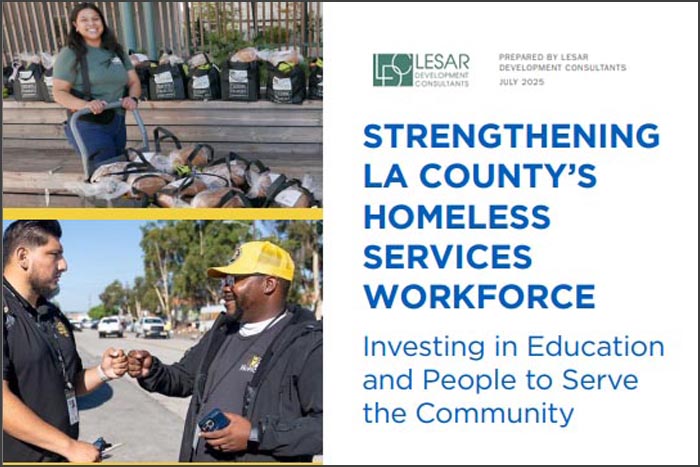
LeSar Development Consultants (LDC) has partnered with Los Angeles County’s Santa Monica College to examine workforce challenges in the County’s homelessness sector and explore how community colleges can be an important partner in addressing training and onboarding gaps experienced by new frontline staff in homeless services.
The report, published late last year, analyses current workforce conditions across LA County’s homelessness response system, one of the largest in the nation. With an estimated 8,000+ workers employed across outreach, interim housing, permanent supportive housing, prevention, and supportive services, the County’s homeless services system plays a vital role in connecting people experiencing homelessness to care. Yet despite its size, the workforce is under intense strain. The report estimates that the system faces over 1,300 vacant positions, with the most acute shortages in frontline roles such as outreach workers, case managers, housing navigators, and peer specialists.
This report’s analysis is grounded in three core inputs:
- Sector research from recent studies by KPMG, RAND, the National Alliance to End Homelessness, and others
- Available labor market data and job posting analysis
- A 2025 LDC Survey of frontline and supervisory staff in LA County’s homelessness response system
Findings include:
- Recruitment and retention challenges are systemic. Wages often lag far behind the region’s cost of living, making it difficult for workers, many of whom are deeply mission-driven, to remain in the field long term. Entry-level staff frequently report inconsistent onboarding and limited early training, leaving them underprepared for the realities of trauma-exposed work. High caseloads, safety concerns, and the emotional toll of working in crisis environments contribute to burnout, compassion fatigue, and turnover.
- Such workforce challenges directly affect system performance. Vacancies and turnover disrupt continuity of care, slow housing placements, and place additional pressure on remaining staff. Over time, this instability undermines outcomes for people experiencing homelessness and weakens coordination across agencies and programs.
- Education and career pathways are key to the solution. A major focus is Santa Monica College’s Homeless Service Work Certificate program, which was developed in response to employer feedback and workforce data. The program is designed to professionalize and stabilize the field by providing structured, practical training aligned with real-world job demands. Coursework covers trauma-informed care, crisis response, systems navigation, ethics, cultural humility, and worker self-care skills that are essential but often learned informally on the job.
Strengthening the homelessness response system will require sustained investment in the workforce alongside housing and services, and shared commitment from educational institutions, public agencies, and service providers to align training, career pathways, and partnerships. By treating workforce development as a core system function, rather than a secondary concern, the region can build a more resilient and effective response to homelessness, recognizing that lasting progress depends on supporting the people doing the work every day with the tools, stability, and pathways they need to succeed. For more information, please reach out to Colleen Murphy at [email protected].
🔗 Read Strengthening LA County’s Homeless Services Workforce Report
🔗 Listen to LDC’s Colleen Murphy discuss this report on SMC’s Doing What Works Podcast (Season 2, Episode 10)
© LeSar Holdings/LeSar Development Consultants. All Rights Reserved. Please be advised that any republishing of copyrighted material provided by our organization, in whole or in part, requires prior written authorization. For permission, please reach out to [email protected]. We appreciate your understanding and compliance in upholding copyright laws.

Related Articles



















About the Author