

Article Contributor: Lizeth Hernandez Herrera, Case Manager, Jewish Family Service
Despite the intractable nature of homelessness nationally, local success can still be achieved through coordinated, housing-focused systems, as demonstrated by Luke’s story in Palm Springs. For Luke, life on the streets felt like a downward spiral until he received support from the City through Encampment Resolution Funding (ERF).
Struggling with mental health challenges, substance use, and deep isolation for many years, Luke reached a point where hope felt out of reach. Everything began to shift during a moment of crisis in early 2025, opening the door to expanded support, connection, and the possibility of a different path forward thanks to the services and resources provided by Palm Springs’ new Encampment Resolution Fund (ERF). What followed was not an immediate transformation, but steady, coordinated support across all the agencies assisting Luke, the kind of system response designed to meet people where they are and walk alongside them toward stability.
Luke was one of the first people enrolled in Palm Springs’ ERF and moved shortly thereafter into the Palm Springs’ Navigation Center. Together, Jewish Family Service, Martha’s Village and Kitchen, the City of Palm Springs’ Homeless Services Coordinator, and LeSar Development Consultants worked together to help stabilize Luke. While the first nine months of Luke’s enrollment were a period of instability, cycling through interim housing opportunities and facing ongoing challenges, his ERF case management team did not give up on him. And this, in turn, helped Luke not to give up. Together, his team secured temporary motel placements that were a better fit for his needs, providing safety and a foundation to begin rebuilding.
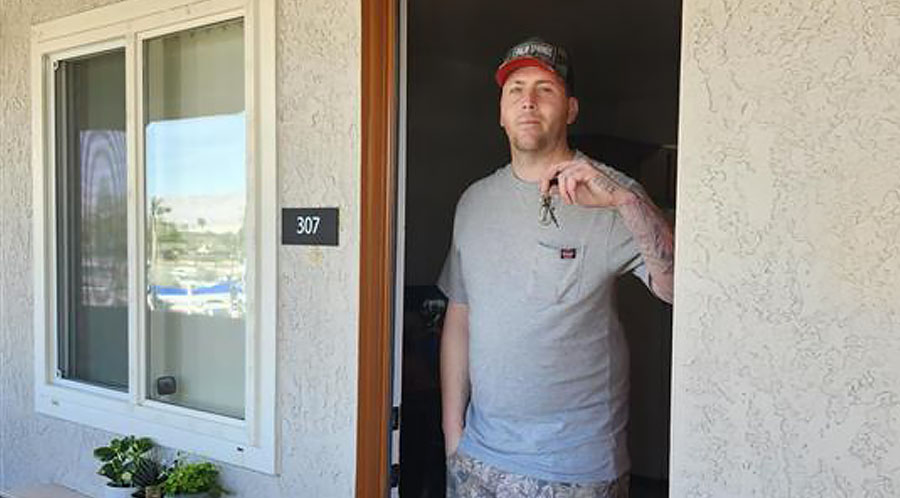
Home at last
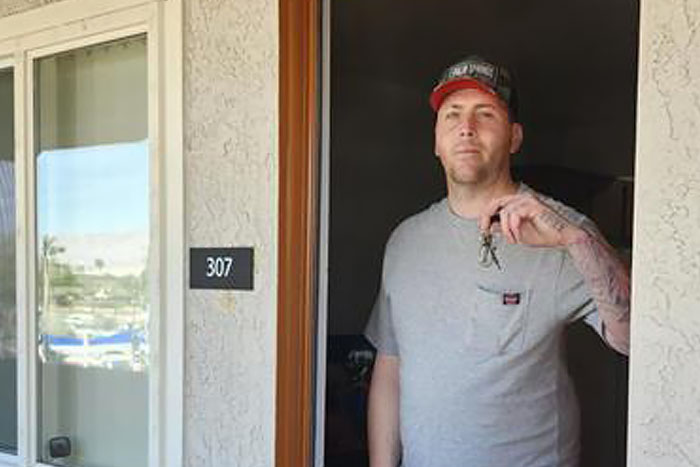
Luke poses with the keys to his unit.
Through ERF and the other critical investments in Palm Springs, Luke gained access to consistent shelter, case management, and critical resources. With stability in place, his engagement deepened: he began attending regular case management meetings, staying connected to care, and rebuilding structure in his daily life.
And on January 6, 2026, Luke reached a major milestone: he moved into permanent supportive housing and finally had a place called home.
Today, Luke is sober, housed, and thriving. He maintains his home with pride, attends Narcotics Anonymous meetings, visits his methadone clinic regularly, and continues to prioritize his mental health and recovery. What once felt impossible now feels within reach.
In his own words:
“I feel happy right now in my life… I’m very happy and proud of where I’ve gotten myself. Each day it feels more real.”
Luke has also found meaning in the routines of daily life: keeping his home clean, caring for his space, and even maintaining an aquarium, which he describes as a coping tool that supports his sobriety:
“I work hard keeping it clean… It’s a coping skill for my sobriety. It gives me something to take care of.”
Just as critical as obtaining housing were the relationships that supported him along the way. From case managers who ensured he made it to appointments, to small but meaningful gestures – rides, check-ins, and encouragement. Luke experienced something many people navigating homelessness are missing: consistent, human connection.
“There were days when you drove me to my doctor appointments and made me feel so important… that alone helped me so much.”
Luke shares his story not for sympathy, but for hope:
“A kind hand, the right resources, and your own determination can lead to a brighter chapter… Life is worth the fight.”

Paying it forward
Luke baked cupcakes for his new neighbors within the first few weeks of moving in as a way to pay it forward and deepen human connection.
As a way to pay it forward and deepen human connection, Luke baked cupcakes for his new neighbors within the first few weeks of moving in.
Today, he is living proof that with the right resources and support, people can find meaning, connection, and healing. Thank you, Luke, for helping us tell your story.
Why This Matters
Luke’s story reflects the possibilities when communities move beyond fragmented responses and invest in coordinated, housing-focused systems. Through programs like ERF and the partnership between the City of Palm Springs, interim housing case managers, outreach teams, and system coordinators, individuals are both brought inside and supported in staying housed and rebuilding their lives.
This is the work LeSar helps communities design and implement: systems that align outreach, interim housing, case management, and permanent housing pathways into one coordinated response. Behind every data point is a person, and with the right systems in place, change is possible.
© LeSar Holdings/LeSar Development Consultants. All Rights Reserved. Please be advised that any republishing of copyrighted material provided by our organization, in whole or in part, requires prior written authorization. For permission, please reach out to [email protected]. We appreciate your understanding and compliance in upholding copyright laws.

Related Articles
















About the Author